UFO Project
Using rotational mechanics to offset linear acceleration in high-G maneuvers
The Idea
I am building a centrifugal system that offsets linear acceleration with rotational mechanics. Long-term, that could support aggressive fighter-jet and missile-evasion maneuvers where the vehicle pulls high G without putting the same sustained load on a pilot or payload.
The setup is an outer frame plus a spinning inner vessel. An accelerometer pod rides on the inner vessel; the control problem is to apply spin torque so centrifugal and tangential terms reduce what that pod feels when the outer frame decelerates hard.
2D RL Prototype
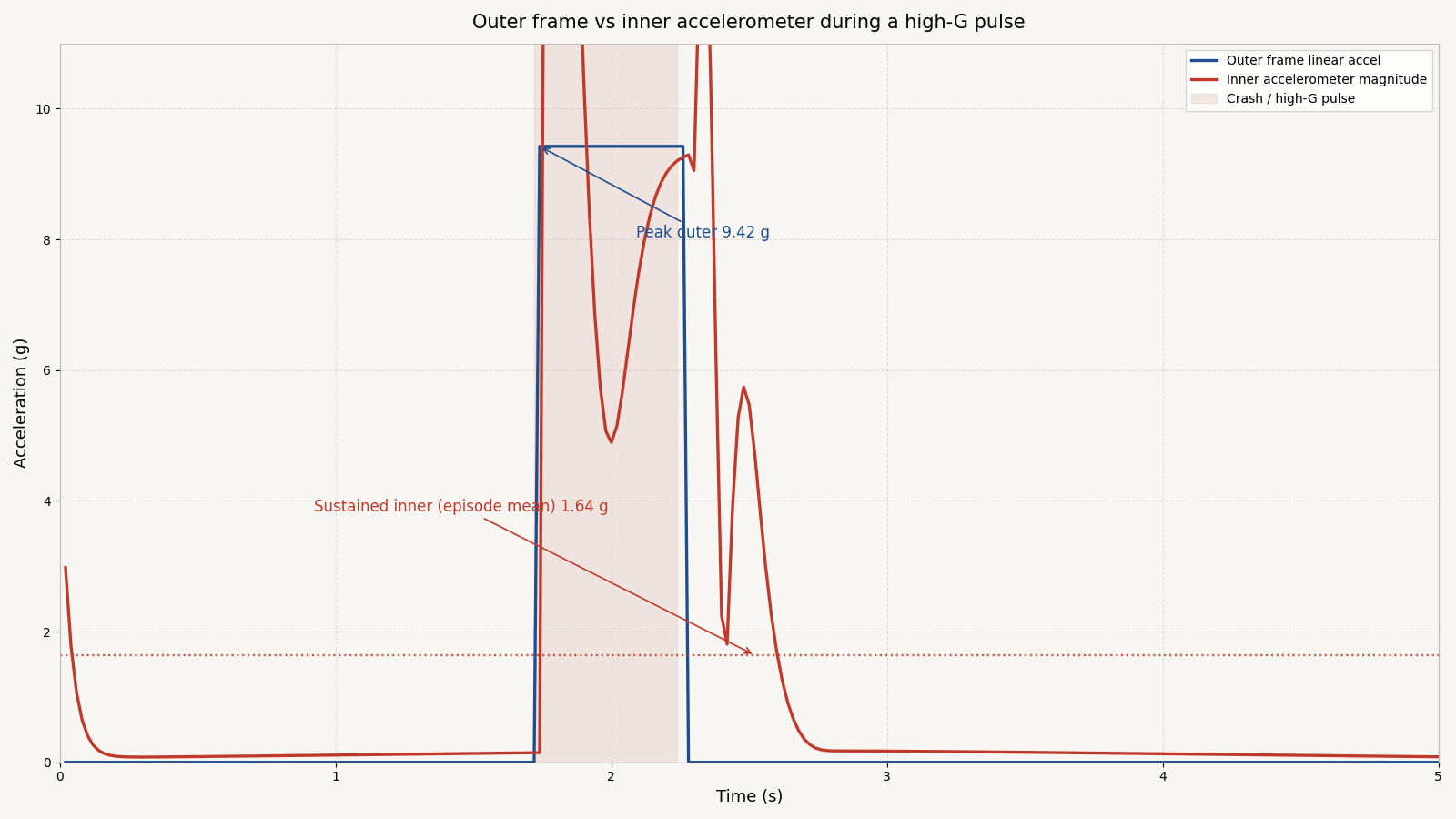
So far this is a 2D Gymnasium environment with a PPO policy that outputs spin torque. Episodes last 5 seconds. At a random time the outer frame takes a short linear pulse between about 5g and 10g (deceleration). The reward penalizes pod acceleration magnitude during the pulse, plus a light penalty on high spin rate.
The demo below is one evaluation episode. During the pulse the HUD shows roughly 9.4g on the outer frame while the inner pod still reads on the order of ~5g mid-pulse, not a fully canceled load. Averaged over the whole episode (including the quiet seconds before and after), mean inner magnitude is about 1.64g. The plot makes that distinction clear: the interesting part is the pulse window, where peaks can still exceed the outer load as the policy is spinning up.
RL was the fastest way to get a first controller without hand-deriving every feedback loop. A more robust classical or hybrid controller comes later, along with motors that can dump enough rotational energy quickly enough for a real event.
Hard Part Next
Software can explore the control idea in sim. Hardware is the bottleneck: finding a motor that can put enough rotational energy into the system fast enough to track a real high-G event, plus a controller that keeps peak pod G down during the pulse, not only the episode average.